


The Mythological Roots of Virgo: From Persephone to the Guardianship of Mercury
Among the vast expanse of the night sky, Virgo stands as the largest constellation in the zodiac, spanning from August 23 to September 22. It symbolizes not only purity and order but also carries a profound and moving mythological legacy. While traditionally associated with the earth goddess Demeter or her daughter Persephone, in certain cultural interpretations, Virgo is also regarded as being under the guardianship of Mercury—the god of wisdom and communication—reflecting a fusion of rationality, meticulousness, and service.
The Fall and Rebirth of the Spring Goddess
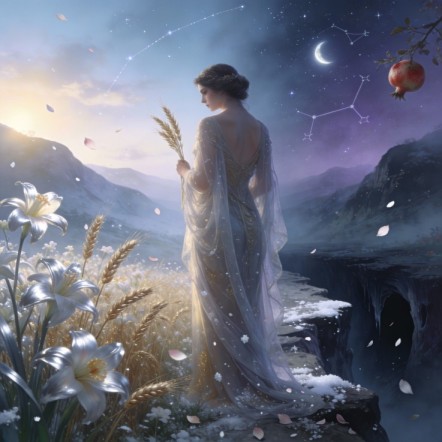
In Greek mythology, Persephone was the only daughter of Demeter, the goddess of agriculture, and was hailed as the embodiment of spring. Wherever she walked, flowers bloomed and life flourished. Yet this beauty drew the covetous gaze of Hades, ruler of the Underworld. One day, while gathering blossoms in a valley, Persephone was captivated by an unusually radiant silver narcissus. As she reached for it, the earth suddenly split open, and Hades emerged in a chariot drawn by black horses, seizing her and dragging her into the realm of the dead. 🌸
Her mother, Demeter, was devastated. Abandoning her duties over the harvest, she wandered the earth in search of her lost child. Without the nurturing presence of the Earth Mother, fields lay barren, crops failed to sprout, and humanity faced famine. Zeus, king of the gods, was compelled to intervene and ordered Hades to release Persephone. But the cunning lord of the Underworld had already laid a trap—he persuaded her to eat a few seeds from a pomegranate of the Underworld. According to its laws, anyone who consumed food there must return periodically.
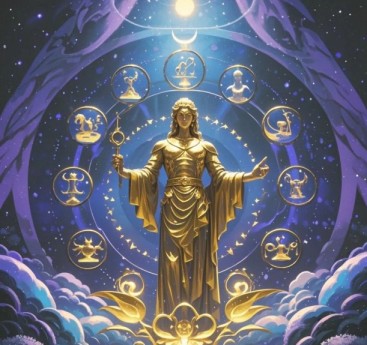
Ultimately, Zeus decreed that Persephone would spend one-quarter of each year in the Underworld and the rest with her mother on Earth. When the ground freezes and vegetation withers, it marks her time below; when spring returns and wheat begins to sprout, it signals her homecoming. Thus, the image of Virgo holding a sheaf of wheat honors both the bounty of the harvest and the eternal bond between mother and daughter.
The Legend of the Justice Goddess and the Scales
Beyond the tale of Persephone, another tradition identifies Virgo as Astraea, the goddess of justice. Disillusioned by humanity’s moral decline after the Golden Age, she chose to leave the mortal world and ascend to the heavens, becoming the constellation Virgo. The scales she once used to weigh human deeds became the neighboring constellation Libra, continuing her role as arbiter. This version underscores Virgo’s deep commitment to order, ethics, and ideals of purity.
The Hidden Guardianship of Mercury
Although mainstream myths often link Virgo to female deities, astrological tradition designates Mercury (known as Hermes in Greek myth) as its ruling planet. Mercury, the messenger god, represents mental agility, analytical thinking, and the coordination of daily affairs. This explains why those born under Virgo often exhibit sharp observation skills, attention to detail, and a natural inclination to serve others as a path to self-fulfillment. This blend of rationality and devotion makes Virgo uniquely distinct among the twelve signs—possessing both the gentleness of a spring goddess and the clarity of a divine messenger.
In summary, Virgo is not born from a single myth but is woven from multiple symbolic threads: it is an elegy for a lost spring, a testament to unwavering justice, and an embodiment of reason and service. As we navigate the celestial shifts of 2026, understanding Virgo’s rich mythological roots may offer deeper insight into the inner motivations and soulful yearnings of those born under this sign—or those influenced by its energy.