





The Mythological Roots of Aries: Ares, the God of War, and the Legend of the Golden Fleece
Among the vast expanse of the night sky, Aries stands boldly as the first sign of the zodiac, radiating vigor and decisiveness. Spanning from March 21 to April 20 each year, Aries symbolizes explosive energy, initiative, primal drive, and the intertwining forces of war and passion. As the inaugural fire sign, Aries not only heralds the awakening of spring but also carries within it dramatic and divine mythological tales passed down through the ages.
The Multiple Faces of the Aries Myth
The origin of Aries is not confined to a single story; rather, three interconnected yet distinct myths have been preserved across time. Though the characters and details vary slightly, all center around a golden-fleeced ram whose intervention alters the course of destiny.
The First Tale: Siblings and Roasted Seeds
In a distant ancient kingdom, a king and his former queen had two children. After remarrying, the new queen, consumed by jealousy over the king’s affection for his firstborns, devised a cruel scheme. During planting season, she secretly roasted all the grain seeds before distributing them to farmers. Naturally, nothing grew, and famine struck the land. She then falsely accused the innocent siblings of provoking divine wrath.
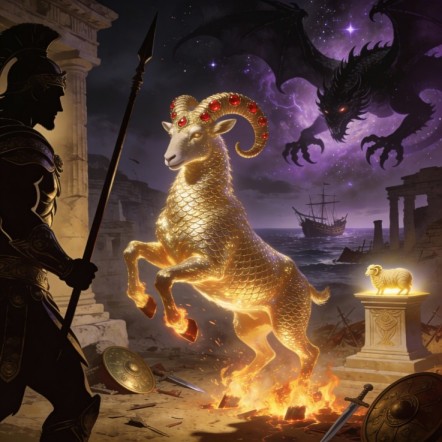
Fearing for their harvest, the desperate people pressured the king to execute the children. At the moment of execution, the former queen pleaded with Zeus for mercy. Moved by her maternal love, Zeus dispatched a radiant golden ram to rescue the siblings from the execution ground. Tragically, the sister fell into the sea during the escape and drowned, while the brother reached safety. To honor this brave—though somewhat careless—ram, Zeus placed it among the stars as the constellation Aries. This tale explains why those born under Aries often embody both fearless optimism and occasional impulsiveness.
The Second Version: The Wrongful Accusation of Phrixus
In another telling, the rescued prince is named Phrixus, son of Athamas (sometimes called Nephele’s son). He was falsely accused of violating the beautiful Biadice and sentenced to death. Once again, the golden ram appeared at the last moment, carrying him to freedom. Sadly, his sister met the same fate—falling into the sea and perishing. Grateful for his salvation, Phrixus later sacrificed the ram to Zeus, who then immortalized its image in the heavens as the constellation Aries.
The Third Chapter: The Golden Fleece and the Hero’s Quest
The third version expands into an epic sequel—the legend of the Golden Fleece. After the ram’s sacrifice, Phrixus gifted its precious fleece to King Aeëtes of Colchis. The king treasured it so deeply that he assigned a sleepless dragon to guard it day and night. Years later, Phrixus’s half-brother Jason assembled the Argonauts and embarked on a perilous quest to retrieve the fleece. With the aid of Medea, the king’s clever and passionate daughter, Jason not only secured the Golden Fleece but also eloped with her.
Though this continuation extends beyond the original myth of Aries, it remains intrinsically linked to its origin. It illustrates courage, sacrifice, and how the fate of one golden ram wove together the destinies of countless heroes. The core spirit of Aries—pioneering boldness, unwavering forward motion, and raw life force—stems directly from these ancient narratives.
As we approach the year 2026, reflecting on these timeless stories allows us to reconnect with the essence of Aries: the courage to charge ahead, the resilience to face adversity without retreat, and the primal drive to carve new paths through chaos. No matter how much the world changes, the soul of Aries continues to shine like an eternal star. ✨