





Writing in the Ruins: A Writer's Solitary Resolve
After graduating from university, I tried every kind of job imaginable—accountant at a shipping company, server at a KTV lounge, and nearly even a salesperson for columbarium niches—all in an effort to balance survival with my dream. Yet no matter how circumstances shifted, my desire to write novels never wavered. The path was lonely and arduous, but I had no choice; I could only stubbornly press forward.
A Three-Ping Sanctuary
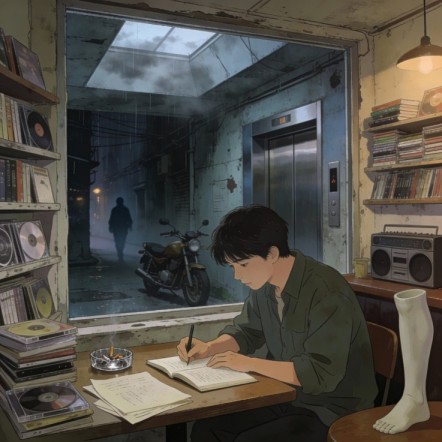
Choosing not to pursue a stable teaching position or a publishing career, I moved back to Taichung after graduation and rented a tiny three-ping apartment in a dilapidated building near Chinqin Theater. The elevator groaned like it might collapse any moment. Inside my unit, there was no sunlight—only a small window facing an airshaft, a crude kitchenette, and a worn-out bathroom. Rent was NT$5,000 per month.
My entire worldly possessions consisted of a few hundred books, an audio system, dozens of CDs, a handful of clothes, and several collected ashtrays. Ever since leaving the dormitory in my sophomore year—where memories were too painful to revisit—I refused to share housing again. Though rundown, this little room became my sanctuary. Outside chaos reigned, but as long as I could read, listen to music, and write, my world felt complete. Reality, however, soon knocked: I ran out of money and urgently needed a job.
Columbariums and Coffee Shops: Detours on the Path to a Dream
My first job was as an “administrative assistant” in Beitun District. On my first day, dressed in a suit, I entered an office full of fresh graduates. But the so-called training turned out to be motivational fluff about success. By day three, the truth emerged: it was a multi-level marketing scheme selling columbarium niches, using fake surveys to lure customers. I quit that same day, standing by a noisy roadside payphone, telling my boyfriend what happened. He laughed, “If you stayed longer, you’d probably buy a niche yourself—and pay them to take it!”
With savings nearly gone, I quickly landed a second job: “editor for a Taiwanese dictionary” at a small neighborhood café. The owner, long-haired and artsy, hired me on the spot. Business was slow, so most days I copied Mandarin vocabulary from elementary textbooks and transcribed them into romanized Taiwanese. In the quiet emptiness, I brewed coffee and secretly wrote fiction, briefly believing I might finish a short story soon. But the dream faded fast—due to losses, the owner cut my hours in half and slashed my salary to NT$12,000. With rent alone costing NT$5,000, survival became impossible. Once again, I scoured the newspaper’s classifieds.
Daily Life in the Ruins, Glimmers of Light
I then worked as an accountant for a shipping firm and later as a DJ at a KTV, eventually switching to server duties. The KTV was located in Taichung’s Twin Star Building, and my night shifts ended at 1 a.m. There, I met two remarkable coworkers: Annie and Mei-hui. One was sweet and innocent; the other cool and enigmatic. Both were entangled in complicated family dramas and romantic struggles. We bonded over cigarettes in the break room, becoming each other’s fleeting yet genuine refuge.
To save NT$200,000 and quit to write full-time, I endured everything—tips stuffed into my skirt, harassment from managers, sudden departures of friends. Annie was once forcibly kissed by the manager in the restroom; Mei-hui, estranged from her mother, decided to work in a hostess bar. Their stories revealed the world’s complexity and deepened my resolve: even amid ruins, I would write my own words.
Stubbornness: My Only Belonging
One morning after shift, I was hit by a motorcycle while crossing the street. Though only my knee was injured, an intern doctor inexplicably cast my entire leg in plaster, ordering three months of immobility. My parents, thinking I’d broken a bone, strongly opposed my return to the KTV. During two weeks of convalescence at home, I finished a short story—then returned to my sunless apartment.
I never saw those coworkers again, but whenever I pass the Twin Star Building, memories of those sleepless nights resurface. Riding my secondhand scooter—nicknamed “Phoenix”—through pre-dawn streets, I often wondered: when will this life improve? The answer remained elusive. Yet a clear voice inside kept repeating: this is my life, and no matter how hard, I must write novels. The future is distant and uncertain; the dream seems impossible. But beyond this stubbornness, I have nothing else—and it is precisely this stubbornness that allowed me to fulfill my earliest literary dream amidst the ruins.